Technorati Tags:
Organic,
Health Food,
Natural Food,
Cooperatives,
Coop,
Coops,
Omnivores Dilemma,
Organic Inc,
Slow Food Nation,
PSU,
CapstoneCreate a proposal for our community partner, People’s Food Cooperative, identifying…
1. A problem area related to a wider food politics or food industry context (this should be a paragraph or two summarizing general trends, with references to readings; include a bibliography at the end).
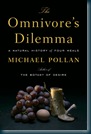 In The Omnivore’s Dilemma, we learned that food choices often seem simple when, in fact, our choices are based on a complex underlying system; a system where understanding the details or specifics of the entire food chain: from growth, to processing, to shipment, to the final destination of the dinner plate complicates the omnivore’s dilemma: “What should we have for dinner?” We are raised with traditions; traditions that have evolved to keep us nourished and safe; traditions that developed along with our eco-system over a great period of time. Recently, mass production and its associated processing have fueled a separation or a widening gap between the farmer and the end-user: the consumer of food. Michael Pollan identifies the issues with modern chemistry and the underlying effects of feeding animals, like corn-fed beef. Today’s beef is greatly different from the beef of 50 years ago (one could say we feed them unnaturally) and the politics of the food industry today surround transparency, truth, sustainability, and a deeper understanding of our food system. The rising growth of cooperatives, demand for local food, and demand for organic food are testaments to these concerns: cooperatives are centered at the core of food industry politics.
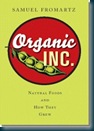 In Organic Inc., Samuel Fromartz starts with a search for tasty, wholesome food and begins a journey of exploration related to food. His journey was about becoming a more informed consumer.
“Another study looked at pesticide residue data from 94,000 food samples from 1994-1999 and found organic food had about two-thirds less residues than conventional food.”
(Organic Inc. p2)
Samuel became concerned, along with many others, that the widespread use of pesticides may be inflicting a multitude of health problems. Key to most, if not every definition of organic food versus conventional food, is the restricted use of pesticides. While there is no universally accepted definition of organic food, the general idea is that pesticides and chemical use (especially synthetic fertilizers) is substantially restricted. In order to fertilize “naturally” crops should be rotated, the over-all eco-system should be managed to use natural means to control pests, bacteria, and diseases versus chemical or man-made means. The goal is sustainability and the healthiest most wholesome food as a product.
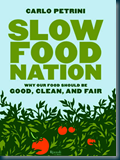 Carlo Petrini in ‘Slow Food Nation’ emphasizes that the rush for quick industrial solutions is killing the soil; it comes at great expense. Plants could not grow – naturally – in the densities and quantities maintained today without artificial assistance. Further, the global eco-system effects are substantial. Not only does he believe our current industrial food system is unsustainable, he believes it is dangerous. Carlos offers more than awareness in his book, he leans towards solutions and the following quote demonstrates Carlo’s direction towards a solution:
“We must begin, in this case too, by rejecting everything that is unnatural, everything that introduces unsustainable artifice into the relationship between man and earth”
(SlowFoodNation p110)
These books highlight why people have been collectively gathering to form cooperatives; they are all related to issues surrounding the industrial food industry and highlight significant problems. Local food market or grocery cooperatives all seem to spawn as a way to build awareness and develop solutions related to the food industry by reaching out - directly - to community members.
 People’s Food Coop adopted the seven cooperative principles (SevenPrinciples) and these principles are the core foundation underlying the organization. Our proposal directly relates to the trend of growth related to coops and the potential impact coops have upon their respective communities. Our specific proposal stems from concerns directly expressed by People’s members: to develop community awareness and outreach with particular emphasis to maintain diversity, avoid oppression, and maximize the community’s perception of People’s such that they are perceived as open to all community members.
2. The position of a food coop like People’s, in the expanding natural food industry and in local markets (this should be a paragraph or two based on your reflections of the site visits to natural food stores and coops in the Portland area, as well as your understanding of People’s mission, history, and short/long term plans – refer to actual documents and figures when you can).
 People’s represents an extension of the community itself where the community concerns are the basis of their principles. People’s members seek a true democracy. Contained within People’s mission, vision, and values statement:
“We envision an involved & active community, cultivating an evolution of society by advancing localization, the cooperative principles and values of social, economic and environmental responsibility.” (PeoplesVision)
People’s represents decision making on a collective basis. Their goals are based on long-term thinking with an understanding of the full-cycle affects on the decisions made. In other words, they don’t just consider the quality, nutritional value, price or other traditional capitalistic features of a product alone; they consider the local impacts on the earth, the eco-system, the food chain, the environment, and society. Thus, sustainability and social responsibility are major identifying characteristics encompassing their organization. People’s manages decisions collectively via consensus:
“The Collective at People’s uses consensus for full-group decision-making in the log and at staff meetings. The same principles we use in these settings can also be applied to teams, committees, and other small groups.” (PeoplesConsensus)
The employees at People’s are paid based on a “Living Wage” principle and no employee should earn more than slightly twice that of the lowest paid employee. This reflects People’s particular emphasis of collective equality. This quote (from People’s ‘Green Features’) emphasizes People’s commitment to sustainability:
“We took extensive measures to build a store that lessens environmental burdens & strive to run it with a minimum of resources.” (PeoplesGreen). These green features were also found in pamphlets distributed throughout the store.
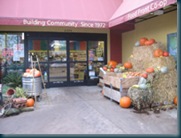 The Food Front is a cooperative grocery emphasizing democratic “capital” ownership.
“As a consumer cooperative, Food Front builds from the vision of its owners to strengthen and extend the social fabric by democratizing capital ownership (social, natural and economic) to create a sustainable community.” (FoodFrontMission)
In our meeting with Lee Lancaster, the Finance Manager of Food Front, we learned that the overall capital ownership is essentially the same as People’s where members can buy a single share for a relatively low price and have options to make payments over a long period. Owners can opt-out and their original capital investment will be returned. Both cooperatives can earn profits, but the profits either fund growth and/or some portion may be returned to members based on their level of shopping. Both stores operate to serve their communities and their respective members and membership has some level of privileges.
The Food Front seeks organic and local food, but does not limit the food offered to local and organic. Currently, People’s is a vegetarian only food market. It is unclear if People’s will remain vegetarian only or they will eventually offer meat products. The Food Front does offer meat:
“Our meat and poultry is from pastured and free-range animals raised naturally by ranchers who are committed to sustainable practices and humane standards.” (FoodFrontMeat)
Further, Food Front offers more conventional foods than People’s. Some may consider People’s more restrictive and less accommodating while others may taut their resolve on principles. There is simply a difference between the stores based on product selection. We also learned in our meeting that the Food Front has a more traditional management structure and they do not have any specific ‘living wage’ guidelines, nor do they have a cap on employee wages. One may find that it is possible to earn higher wages for certain positions at Food Front compared to People’s. One may also find that People’s offers a higher minimum or a higher floor for their employees. Decisions at Food Front are not necessarily based on consensus; management members make decisions through greater autonomy at Food Front than at People’s. Generally, People’s tends to be more collectively organized than Food Front.
Our proposal concentrates on the relationship between People’s and its surrounding community including other organizations and cooperatives. Maybe other cooperatives have differences that could be modeled for future changes, or maybe the differences are already more beneficial for People's and no changes should be implemented. We do not seek to have pre-conceived results, only to be open to what the results indicate; albeit, some form of bias is nearly impossible to eliminate.
3. A research strategy for investigating the problem you have identified, including:
a. Your methodology - how you will study the problem you identified.
In order to achieve our goals, we intend to address these questions:
1) Are the demographics of People’s membership representative of its surrounding community?
The intent is to discover if there are any discrepancies that may indicate some violation of the cooperative principles and to address these concerns directly. To achieve this, we need to compare the results of existing polls that provide demographic information as well as the opinion of People’s membership collected during the polling process. We will then compare published demographic data to the polls.
2) Is People’s product selection/availability limiting or even oppressive?
We have members of our team that theorize that many people cook their meals based on their respective customs and traditions; therefore, they shop where selection is most aligned with their respective meal choices. Simply put: many Mexicans tend to eat Mexican food, Hungarians eat Hungarian, and orthodox Jews only eat food acceptable to their traditions and beliefs. We intend to examine the product selection of other food markets within People’s surrounding region and examine product availability. We intend to discover if simple product selection choices could inadvertently result as some form of barrier between community members and People’s. The main goal is to expand awareness.
3) How could People’s maximize community outreach and openness?
In order to answer the previous two questions, we would have to collect and analyze demographic data, polling data, and use our own observations. The previous two questions may highlight potential problem areas or identify that no significant problems exist. Either way, we believe recommendations towards improvements, better efficiencies, or even solutions to problems identified should coincide with the results.
b. Your theories about what you would expect to find from your study.
People’s must face interesting dilemmas related to their principles and their business strategy. Thus far, People’s have run their coop as a no-meat market. This is one element related to question (2). The Food Front and other coops have not elected to eliminate meat and it appears that offering meat is not a violation of the coop principles. According to a poll conducted by the Vegetarian Resource Group in 2006 (VegetarianJournal), 2.3 percent of adults aged 18 years or older say they never eat meat, fish, or fowl and, thus, are vegetarian. Is People’s choice somehow affecting or limiting the involvement of others because of its decision to be vegetarian? Not offering food that is consumed by 97.7% of the population is significant and we expect to find that this is a factor.
As we noted in question (ii), we also suspect that product selection may be a factor in limiting or restricting certain community members. We would seek to understand some level of significance and what solutions may be possible.
c. An approximate timeline which demonstrates the steps your group will take to research and conclude your project, including particular student responsibilities.
Members: Ersun, Joe, and Trevor
Objective: Determine if the demographics of People’s Food Coop is representative of its surrounding community and identify disparities or inconsistencies, if any, that may be indicated from our observations. We are also attempting to identify community organizations where a bond can be formed between People’s and the respective organization. The purpose is to ensure that People’s is perceived as open as possible to all of its respective community members. Each member is assigned a zip code within an area targeted as potential growth (a new store) for People’s and these areas (zip codes) may simply have a different mix of community members; therefore, the different strategies may need to be applied to expand into such an area; our task is to identify any notable differences that may impact expansion decisions.
Method: Compare demographics and statistical information (as collected by People’s Food Coop via member surveys) with subjective data collected as objectively as possible, individually, in the following three zip codes: 97214, 97215, and 97206. We are each to note demographic, product, community or any relevant differences between the community and People’s current membership. Each member is assigned a zip code, and each member is tasked with researching their respective zip code including physically visiting, photographing, and collecting data from at least two food stores and one community organization. The organization must have what we would estimate as strong potential to develop a long-term relationship with People’s.
Product: A final presentation based on Microsoft Power Point supporting summary documentation for use by People’s members as needed. There are three major areas to develop the project besides the individual data collection: The Power Point Presentation, The Combined Data Summary (charts/tables), and The Written Summary. The product should note any differences, if any, between People’s membership and its community members that may affect the perceived ‘openness’ of Peoples to all community members. The product should offer suggestions related to potential store expansion related to openness or the perception of community members as well as any basic ‘outreach’ suggestions. Further, the report may suggest any number of ideas, programs, or alternatives that affect People’s, cooperatives in general, the community in general, or any aspect that seems relevant to the task.
Timeline
Wednesday, February 27th
Trevor:
· Contact SE and obtain list of potential contacts/organizations
· Buying Clubs
· Coops (an type, not just food)
· Churches/Charities
· Any organization open to relationship with People’s (if not why?)
· Create (this) Timeline Document
Monday, March 3rd
All Members:
· Individually contact, photograph, and collecting data from at least two food stores and one community organization with strong inclination for positive relationship with People’s. Have summary data and photos ready for all members. Meet to discuss preparation for Wednesday, March 5th and assign tasks as necessary.
Ersun:
· Have collected and summarized his individual data (including photos) related to his zip code (97214)
· Collect relevant snippets and summarize from the data collected in People’s membership surveys with emphasis on the expected (anticipated) finding discussed in group meetings.
· Estimate the results from the other members to have ready a ‘rough draft’ of the data summary needed for the overall final product (to include charts and tables) – related to above.
Joe:
· Have collected and summarized his individual data (including photos) related to his zip code (97215)
· Have a ‘rough draft’ of the summary report (based on estimate of other member’s results)
· Collect and summarize information on ‘buying Clubs’ (if completed early – email to group members)
Trevor:
· Have collected and summarized his individual data (including photos) related to his zip code (97206)
Wednesday, March 5th
All Members:
· Have discussed and combined individual aspects into a “rough draft’ final such that it should be ‘mostly-complete’ per the tasks assigned on Monday, March 3rd.
· Assign tasks, as necessary, to “polish” the final presentation. Be prepared to perform unexpected tasks in order to meet unexpected challenges. Essentially, we need to be ready to to do what is necessary for the group.
Monday, March 10th
All Members:
Be prepared for Executive Summary of final (brief synopsis) – the product should be done at this point, although it could still be ‘tweaked’ for best effect as necessary. It is a ‘bad sign’ to still be working in any major capacity on the project at this point. Again – tweaking is expected and just fine. We should have some time set aside, ‘just in case’.
Wednesday, March 12th
All Members:
Make final Presentation on group project!!
d. The form of final presentation that will most clearly communicate your findings.
The final presentation will be a personal presentation via Microsoft Power Point in conjunction with summary documentation or an executive summary for use by People’s members for later reference.
e. The final product that you will have finished by the end of the term.
The product is a summary of findings related to the comparison of people's membership and People's surrounding community. The product should note any differences, if any, between People’s membership and anything that may be affecting the perceived ‘openness’ of Peoples by its community members. The product should also offer suggestions related to a potential store expansion into southeast Portland. Further, the report may suggest any number of ideas, programs, or alternatives that affect People’s, cooperatives in general, the community in general, or any aspect that seems relevant to the task.
4. How will YOU, personally, focus your time and energy on this particular inquiry?
I will travel to the southeast area of Portland (related to the zip code assigned as well as the general expansion area) and physically visit numerous related food stores to compare demographics, food selection, price selection, and other relevant criteria. I will physically visit other cooperatives (not just food cooperatives) and community organizations to try and establish potential partners with peoples and gain further understanding about the community.
In addition, I will take a camera and collect photographs for use within the Power Point presentation. Throughout the process we are to seek any relevant information that may be pertinent to a potential expansion into southeast Portland.
My assigned task is not only to collect individual data to be combined into a group summary, but I am solely responsible for the creation of the Power Point presentation; therefore, I am also the presenter. The individual task assignments were discussed collectively and agreed to by all members of the group. If the presentation is not satisfactory, it is a reflection upon my individual effort.
Certainly, a significant portion of the overall effort is making sense of all that we collect to produce information out of the data. Even more challenging is taking the time to research appropriately (many hours online), to relate our course content (read and reread text books and notes), and put together something that reflects upon the assigned task, is on time, and to prepare and practice in order present professionally.
5. How do you think your inquiry relates to the four University Studies Goals? Name the goals and describe how you think your project relates to them.
- Critical Thinking - our group was tasked with identifying differences, if any, between People's Food Coop and its surrounding community. We have to collect data from surveys, perform observations, and draw conclusions based on evaluations of our findings. There are numerous aspects involved: race, gender, age, culture, or any of many aspects that may be deemed pertinent.
During our course, we read: The Omnivore's Dilemma, Organic, Inc., and Slow Food Nation. We watched various films such as Super Size Me and King Corn. All of the course content was geared to help us understand issues specifically related to the Natural Food Industry. In this material, we learned about cooperatives, the seven cooperative principles, issues related to sustainability, and issues related to community. All of the material is relevant to our task and requires us to consider the issues raised deeply.
Most importantly, our task requires that we cross over or transcend beyond theory and into practice as we are directly involved with organizations and community members that are within or impacted by the natural food industry.
All of these elements require substantial critical thinking in order to draw conclusions based on the myriad of resources available.
- Communication - We have to collect observations individually, share our observations with each other to create group conclusions, and then need to create presentations and summaries to others orally, verbally, via charts and graphs, as well as through group presentation.
Our task touches nearly every possible form of communication: speaking, informal email, formal writing, informal and formal presentation, Internet blogs, and Power Point based presentations.
In order for our task to be completed, we must continually communicate with People's members, group members, the instructor, as well as various members of various organizations within the community.
Overall, our task requires demonstrated communication ability via most communication channels.
- Ethics - Our task addresses ethics head-on as we are directly collecting information and drawing conclusions to answer the question, "Is People's perceived to be 'open' by its respective members of its community." We need to consider potentially sensitive areas such as race, gender, culture affiliation, economic identity, or any number of potential areas that may directly or indirectly oppress a certain group of people. The oppression, if any, may be real or perceived and not only are we building awareness related to ethically significant areas, but we are also leaving the classroom environment and are interacting directly with the outside community.
Our own ethics are possibly challenged: if we happen to discover any form of oppression, it can be ethically challenging to address the issue appropriately.
We must interact with people while maintaining sensitively and by applying caution. Are our words, phrases, or actions possibly offensive or inappropriate? Just trying to collect information in sensitive areas can lead to potentially problematic scenarios, if not handled appropriately.
Our task is an ethics topic.
- Diversity of the Human Experience - our topics deals directly with understanding and appreciating the multitude of differences between a diverse (varied) people and their unique respective experiences. We could not align more perfectly to address this topic. Even a small section of Portland, let alone the members of a single cooperative, contain a wide variety of human experience. There are differences in age, differences in income, differences in race, differences in religion, and music, and culture, and on and on.
We are tasked directly with researching and understanding the diversity of People's Food Co-op and are required to research and understand the section of community surrounding People's. We are assigned with comparing the results such that we make determinations, learn, and ultimately share our knowledge and experience with People's.
We found differences and addressing these differences is enlightening and challenging and covers ways to appreciate differences in food selection based on traditional/ cultural values and habits, based on religious beliefs, based on affordability, based on the impact to the community, and based on sustainability: the overall impact on the environment, its ecosystem, and its people.
Our task was all about and is an in-depth study of the diversity of the human experience.
References
Capstone
Portland State University, www.pdx.edu
"Senior Capstone"
March 2008
http://pdx.edu/unst/capstone.html
SevenPrinciples
People’s Food Cooperative, www.peoples.com,
“The 7 Cooperative Principles”
Feb 8, 2008
http://www.peoples.coop/idea/coopprinciples
International Co-operative Alliance, www.ica.coop,
“Statement on the Cooperative Identity”
26 May 2007
http://www.ica.coop/coop/principles.html
PeoplesVision
People’s Food Cooperative, www.peoples.com,
“Vision, Mission & Values Statements”
Feb 8, 2008
http://www.peoples.coop/idea/Vision/vision
PeoplesGreen
People’s Food Cooperative, www.peoples.com,
“Green Features”
Feb 8, 2008
http://www.peoples.coop/store/greenfeatures/
PeoplesConsensus
People’s Food Cooperative, www.peoples.com,
“Consensus”
Feb 8, 2008
http://www.peoples.coop/idea/consensus/
FoodFrontMeat
Food Front Cooperative Grocery, www.foodfront.coop,
“Meat & Poultry, Seafood”
2006
http://www.foodfront.coop/WhatsinStore/MeatSeafoodPoultry/tabid/115/Default.aspx
FoodFrontMission
Food Front Cooperative Grocery, www.foodfront.coop,
“Our Mission”
2006
http://www.foodfront.coop/AboutUs/MissionPurpose/tabid/120/Default.aspx
Food Front Cooperative Grocery, www.foodfront.coop,
“Food Front Ends”
2006
http://www.foodfront.coop/AboutUs/Ends/tabid/121/Default.aspx
OmnivoresDilemma
“The Omnivore’s Dilemma, A Natural History of Four Meals”,
Michael Pollan
2006. Penguin Books
OrganicInc
“Organic. Inc., Natural Foods and How They Grew”,
Samuel Fromartz
2006, 2007
A Harvest book, Harcourt Inc.
SlowFoodNation
“Slow Food Nation, Why Our Foods should be GOOD, CLEAN, and FAIR”,
Samuel Fromartz
2005, Rizzoli Ex Libris, Rizzoli International Publications, Inc.
VegetarianJournal
Vegetarian Resource Group, www.vrg.org,
“How many adults are vegetarian?”
2006 Poll
http://www.vrg.org/journal/vj2006issue4/vj2006issue4poll.htm
