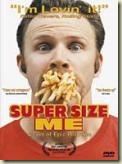

Morgan Spurlock started a craze, a revolution, maybe a even a war with his much hyped 'Super Size Me' film. Michael Stusser, in contrast, possibly as an equalizer, possibly as an opposing point of view, or possibly just to simply get attention wrote a related article, 'Organicize Me'. Here are my reflections:
SUPER SIZE ME:
In 'Super Size Me', Morgan consumes nothing but McDonald's food for 30 days. As a result, Morgan reported these conditions after 30 days:
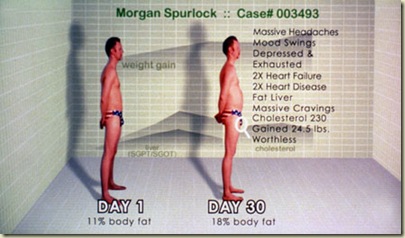
- Massive headaches
- Mood swings
- Depressed and exhausted
- Two times more likely for heart failure
- Two times more likely for heart disease
- Fatty liver
- Food cravings
- Cholesterol increased from 180 to 230
- He gained 24.5 pounds.
Wow! By this assessment, it appears that choosing to eat at McDonalds is equivalent to choosing a death sentence.
Morgan chose to eat a variety of food items as offered by McDonalds restaurants: he had to select and eat items directly from the menu and he had to eat each food item offered on the menu at least once. If he was offered a "super Size" meal, he would always accept. Morgan would eat nothing but McDonald's meals three times a day for thirty days. Further, he also chose to modify his exercise habits to match that of a typical American and/ or that of of a typical McDonald's client - per some unknown estimate.
What was 'right' about the video:
- In my opinion, Morgan identified how McDonalds (at least at the time) does NOT offer well-balanced meals. How many people would suspect that most of the salads were as fatty or more than a Big Mac? I define 'balanced' as consuming the generally accepted 'Percent of Recommended Daily Intake' (RDI) as published by the FDA(http://www.cfsan.fda.gov/~dms/foodlab.html).
- Morgan offered a sense of credibility by seeking and providing the results of continuous medical examinations throughout the 30days.
- McDonalds advertises in such a manner that I conclude that the overall nutritional content of McDonalds foods is is not likely to be understood properly to the point that the average consumer is mislead and unable to make proper nutritional decisions regarding McDonalds food selection.
I happened to be in Germany from 1986 to 1988 and prior to my arriving, Americans were already understanding/ awakening to the high fat, low nutrition content of McDonalds food. McDonalds, due to increased consumer activism and a sense of truth in advertising, stopped advertisements that implied the Big Mac and other high fat foods were overall nutritious. The advertisements switched to taste and alternate menu items began to appear. However, for me, while I was in Germany (at the same time as the new changes emerged in American advertising) every placemat in a McDonalds restaurant still claimed the Big Mac to be highly nutritious. The restaurant was plastered with misleading and inaccurate claims of high nutrition and high health benefits everywhere within a German McDonalds.
McDonalds management clearly knew better based on the emerging activity/ advertising trends in America. This fact that management engaged in opposing and alternate advertising schemes (for me) established conclusively that McDonalds management is purposefully deceptive and only driven to 'do the right thing' by acts of law and overall consumer activism.
- McDonalds (at the time) created 'Super Size' product categories where one could reasonably conclude that the average consumer purchased more food than would be healthy by any nutritionist. A 64 oz cola is simply ridiculous for the average consumer to consume for any meal at any time. Part of a proper diet is proper proportions and McDonalds easily violated offering reasonable proportions. McDonalds pushed for sales regardless of impact.
What was wrong with the video:
- Morgan ate "super sized" proportions to the point of
 continually puking. We are led to believe that eating McDonalds food will result (for the typical consumer) in the same severe health risks that Morgan reported.
Is this true?
I noted that the nutritionist constantly pointed out to Morgan that he was eating 200+% of the calories he should be eating. One might believe that McDonalds food is so fattening that a normal McDonalds meal leads to this excessive overeating, but we watched - REPEATEDLY - as Morgan STUFFED himself. He was full and ate more anyway. He threw up and continued to eat. Is this a reasonable test? What would happen to any person any any food to such excess? This is clearly a problem for me such that I consider the effect of such a decision to introduce significant 'biased' within the experiment. This decision was unacceptable, misleading, and malicious in the desire to effect the outcome negatively.
- Morgan was the only data sample. Anyone familiar with statistics and proper experiments knows that one individual is too small of a test sampling to get accurate results. Further, those who are not familiar with statistical techniques do tend to accept self-studies as 'typical' - improperly! This is a known technique to drive persuasion with a preconceived idea, rather than perform some objective experiment - as was inferred. Frankly - this technique clearly worked! The average viewer accepted his results as typical. Knowing science and proper having basic skills in proper experimentation techniques, I cannot accept the results 'as typical' and must conclude - again - that there was malicious intent to create 'hype' and exaggerate results.
- The movie was presented as objective, but is clearly subjective and substantially biased. Morgan's girlfriend is a vegan and made numerous statements more than indicating a substantial bias. Are we to believe Morgan chooses a girlfriend with radically different ideas about food & diet and that coincidentally made a video with an unbiased expectation for the outcome? Or... can we conclude that Morgan intended to 'expose McDonalds'? I think substantial evidence exists to indicate purposeful bias:
- Morgan's girlfriend's is a vegan and Morgan likely has similar beliefs. He intended to 'prove' McDonalds food was bad and began with a preconceived conclusion. A preconceived conclusion - by itself - is not bad, but an effort to conceal bias, and efforts to abuse proper experimentation techniques is telling.
- What was Morgan's activity prior to the experiment? Did he lower his exercise activity? What happens when a person lowers their level of exercise? Is it not reasonable to conclude that reducing exercise while running an experiment to identify the outcome of a changed diet will effect the outcome. Is the effect predictable? I conclude that any reasonable person would know that the chances of increased weight gain rise significantly. One may also conclude that the body could make adjustments to the 'shock' of the change in exercise activity which also skews results. I conclude that Morgan stopped working-out (exercising) for the experiment in order to skew the results negatively.
- What was Morgan's diet prior to the experiment? If he radically changed his diet, and it appears that he did, then his body might overcompensate due to a sudden shock or change in diet. A sudden change in diet likely exaggerates the body's response and further skews results. This is where testing numerous people and increasing the 'sampling pool' would compensate - unless a person maliciously selected people in order to introduce bias.
- Was the real issue McDonalds food or what happens with over-eating in any unbalanced diet situation? My biggest complaint and what seems most obvious is that Morgan overate - regardless of nutritional content. Would he gain weight eating nutritional food at 200+% of a normal calorie intake. I suspect he would. I do accept that McDonalds does not offer a proper balanced diet; especially, when considering the combinations of food that typical McDonald's clients typically consume. Therefore eating any unbalanced diet every meal, for every day, for 30 days not surprisingly would likely lead to health problems. However, what would happen if someone eats nothing but vegetables, no fruits, no meats, no grains - just vegetables. Hmm???
What would happen if a similar test were applied to a different food source? Would we get similar results? Now, that is what I am curious. I want to know and that is exactly is what I was expecting to discover when I read the title to my other referenced article:
ORGANICIZE ME:
By the the very nature of the title, we are led to believe that Michael Stusser was performing an equivalent experiment to Super Size Me. I must state immediately that I was more than disappointed. The article begins with Michael stating he would start an organic-only diet, but was he also going to similarly consume 200+% of a normal calorie intake via organic food? Would he eat until he was sick and keep eating anyway? Would he have three doctors evaluating his medical conditions as he progressed? Would he eat a 'balanced' organic diet and concentrate on one category, like vegetables, or fruits, or grains? After all, if he eats a balanced version, is that an equitable comparison?
Hmm... Did he? No, I think not! What we did get is the knowledge that he bought and ate organic food for thirty days, but there were no doctors, and there was no excessive 'super size' proportions, and he did not make any effort to perform an equitable - biased -comparison. Further, we then get this (some kind of definition of what constitutes organic, an organic guide):

Well - sort of - we got an organic definition more than a guide. We didn't get anything particularly useful to health and nutrition. What we got was the majority of the article proving the point that nobody (even official government sources) really agree on just what makes something - organic and we did get his opinion that many organic foods 'could' potentially be hazardous but without any real scientific evidence or any real serious effort to draw such a conclusion.
Frankly, the article - in my opinion - offered virtually nothing useful other than making clear to me what I WANT to see or get out of article with such a title.
SUMMARY
I want to see an equitable comparison. I want three doctors (or more) involved in an organic-equivalent experiment. I want a similar over-eating approach based on calories. I want a similar diet-shock where the food eaten is likely to be as equally a major switch in diet: something equally outside the range of the participant's normal diet. I don't mean eating poisonous food. I mean eating food that is also nutritionally unbalanced and is opposite the normal diet of the tester.
Is it fair to use an experiment where the diet is actually balanced when we know the diet was far from balanced in the McDonald's test? Is it fair to have an organic test that does not result in consumption of 200+% of a person's expected calorie intake?
I desire to view the results of an equitable test for an 'Organicize Me' equivalent article. The article was nothing close and an utter disappointment: it was pathetic and not worthy - in my opinion.
EVEN BETTER:
What would be proper - of course - would be redoing both tests properly and involving a reasonable sample size - one sample is always insufficient to draw reasonable conclusions. I want what we know about genetics added to the experiments (I. e. people genetically predisposed to weight gain and high cholesterol easily skew small sample size experiments). I want size and height characteristics added to the experiments. I want medical family history added. In other words wouldn't it be nice if someone, somewhere, could actually test these theories properly? What is the problem? It seems that most people already have their conclusions drawn and have no interest in an unbiased study. It seems awfully challenging, if not impossible to get to a truth when each of us start with the conclusion in hand.
